by Priyanka posted at 6:33 PM
Delicious
0

I am re-posting this recipe since it was languishing unacknowledged, not submitted for any events and because i made it especially for the occassion of Holi.
Well, after having written about some scrumptous spicy Maharashtrian dishes, i decided to write about one of the original maharashtrian desserts or rather sweet dish- the puranpoli. Albeit, contrary to non-Indian cuisines, this dessert is not served at the end of the meal but as a part of the meal itself. I did not have to debate about which dessert to write about first- yes you guessed it right. The puranpoli (a sweet indian bread made from gram dal, jaggery and cardamom) is my favorite followed by ukadiche modak (fresh coconut stuffed rice flour dumplings- a favorite of Lord Ganesha) , homemade shrikhand (indian yoghurt flavored with cardamom, nuts and saffron made especially on Marathi New Year's- Gudi Padwa) and narali bhaat (sweet coconut rice). I havent tried making the latter two desserts at home, though i will in the coming weeks, since i have ample time on my hands owing to the summer break.
The name puranpoli comes from puran meaning mixture and poli meaning roti/bread in marathi. Holi is a festival of colors and different states in India celebrate Holi differently. In Maharashtra, Holi, known as Rangpanchami is celebrated by making puranpoli. I remember my mom making puranpoli on Holi , setting some puran aside for the nevedya- an offering to the Gods (which could be had later with lots of ghee). It was one of the few things that i used to miss a lot when i came to the U.S. My mom, being a mom would parcel it to me every time that she made it. But two years back, on diwali, i decided to give it a try myself, with my roomie Ashwini who is also a Maharashtrian. It took quite some effort since we did not have a blender and we did not make a whole lot- just 5-6, but they turned out pretty well. Bolstered by our previous efforts, i decided to give it a try last year on "Padwa" all by myself with some awesome tips from my mom-in-law. I made it with katachi amti and ukadlelya batatyachi bhaji (boiled potato vegetable) and was rewarded by my dear husband and his friends who lapped up the savory dish. And this year i made it again in the name of tradition and because i just love this dish so. Puranpoli is not difficult to make if you use the right quantity of ingredients and is worth all the effort that you put in. It is usually served with katachi amti, a spicy curry (my favorite) and Ukadlelya batatyachi Bhaaji (Boiled potato sabzi) or can also be had with milk, ghee and sugar (my dad's favorite). There are many variations to the puranpoli across different states of India- one amongst them being the Vedhmi- a Gujarati puranpoli made from toor dal (although i prefer the maharashtrian version). The puranpoli is very nutritious and full of proteins and condiments. It is so filling a dish in itself that you cannot have more than 4-5 puranpolis. Hope you enjoy this recipe as much as i have.....
Puranpoli
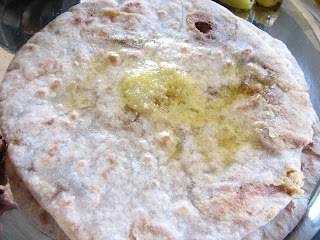 Serves 4 (around 12-14 puranpolis) Serves 4 (around 12-14 puranpolis)
For the stuffing:
3 cups of chana dal 8-9 cups of water (you can add more water, it can be later used to make katachi amti) 15 cardamoms (powdered) 31/2 cups jaggery/ 3 cups sugar (adjust for sweetness) 1/2 tsp nutmeg powder
For the cover or poli:
31/2 cups wheat flour 1/2 cup maida 3 tsp oil
1. Mix the wheat flour, maida and oil and make a slightly soft (not firm) dough out of it. If you do not prefer to add maida, you can make it up with the wheat flour. Keep aside.
2. Pressure cook the chana (gram) dal till it is completely cooked and mashed. Drain all the water from it and keep it aside for katachi amti. 3. Add jaggery pieces (if the jaggery is not too sweet you can add more as per your taste. the sugar is usually added in a 1:1 ratio to the chana dal) and cook it in the microwave (yes!!! a tip from my mom-in-law for an easier and faster version of the traditional laborious puranpoli) till it blends in and all the water evaporates. It should be solid enough to be rolled into balls. 4. Add the cardamom and nutmeg powder and roll into balls. 5. Now make small balls out of the kneaded dough, just like you make for stuffed parathas. Roll out the balls, one at a time into small circles and stuff the puran mixture in it. Enclose it and again gently start rolling out into thin rotis/parathas.(My aai's tip- you dont need to use pressure to roll out the puran poli. Use of rice flour and gently moving the rolling pin around should do the job). 5. Transfer the poli to an already heated tava/pan. Flip when you see golden-brown spots on the side being heated. After both sides are done remove from the tava and put it on a plate to cool. Serve it with lots of ghee.
P.S.-Dont get dissapointed if it breaks the first couple of times. It takes some practice to make a puranpoli without breaking it.
Can a puranpoli ever be served without being accompanied by katachi amti? I would say no. For those of you who have never heard of katachi amti (amti meaning dal/curry in marathi), it is a sweet and sour watery curry made from the leftovers of the boiled chana dal used to make puranpoli. Once you have tasted it, you will never again have a puranpoli without it.
Whatever dishes i have learnt over the years, have been inspired by someone in my life. Most of my culinary skills were honed as a teenager by my mom who is a perfectionist and an amazing cook (i should mention my dad here who always championed whatever we cooked, however bad it might have been- he was the one who taught us how to make phulka polis). However, having left home at the age of 18, i picked up a lot dishes from my friends and roomies from different parts of the country. My experiences and life as a student in the U.S. also led me to come up with easy, quick yet varied recipes to appease my taste buds. I gleaned this recipe from P's aunt, Mangala maushi, who is also a fabulous and enthusiastic cook. In the western world, very few people know of chana dal a.k.a bengal gram a.k.a Cicer arietinum. In India and other Asian countries, its used to make curries and varied other dishes. Chana dal belongs to the family of desi chana, the Indian version of Garbanzo beans/chick peas as we call them; the difference being that they are split, yellow and have much lower glycemic index, making them a favorite of diabetic people.The biggest pro- they are highly nutritious- a good source of zinc, protein and dietary fiber. I havent been able to trace the origin of the bengal gram in India, however the word chana comes from the sanskrit word "chennuka" according to this interesting article by David Mendosa.
Katachi Amti

Serves 4Ingredients:
Use the (8 cups) water drained from the boiled chana dal with some of the puran mixture from my earlier puranpoli recipe or
1/2 a cup chana dal (if making separately, boil with 8 cups of water) 1/3 tsp turmeric 1 tsp garam masala 2-3 tsp tamarind juice/ 2-3 tbsp lemon juice salt to taste 1/3 tsp chili powder jaggery/sugar as per taste 3-4 curry leaves
For the tempering:
2 tbsp oil 1 tsp mustard seeds 1/2 tsp cumin seeds 1/3 tsp turmeric 2 green chilies
cinnamon pieces
2 bay leaves
a pinch of asafoetida
For garnish:
coriander coconut (dry)
1. Take only the water from the boiled chana dal. Add salt, jaggery, chili powder, turmeric powder, tamarind juice, garam masala and curry leaves. (I usually use the garam masala my mom makes. You can either add the ready-made masala with slight variation from the taste or make a paste of 2 tsp of roasted coconut and cumin seeds, 1 cinnamon stick, 2 cloves and 1 bay leaf). You can also vary the quantity of tamarind or lemon juice and jaggery/sugar based on your health and taste needs. I myself prefer the slight sweet yet sour taste. Next, boil the dal.
2. Heat oil for tempering/phodni, add the cumin and mustard seeds. When they start crackling, add the turmeric, asafoetida, chilies, cinnamon and bay leaves and pour it over the dal. 3. Garnish with coriander and serve hot.
I served the Puranpoli and Katachi Amti with Ukadlelya Batatyachi bhaaji, Kelicha raita and Cabbage Pakoras (from Anita of A Mad Tea Party fame). The Cabbage pakoras added just the right touch to complete the meal. Thanks Anita- they turned out awesome.

The boiled potato sabzi is the only sabzi that goes well with this dish or so my family thinketh. The secret to making this sabzi perfect is to make it a little on the crispier side.
Ukadlelya Batatyachi Bhaaji

Serves 2
3 potatoes (boiled and chopped into big cubes)
coriander for garnish
salt to taste
For tempering
2-3 tbsp oil
1/2 tsp mustard seeds
1/3 tsp turmeric
a pinch of asafoetida
5-6 green chilies
8-10 curry leaves
1. Boil the potatoes for two whistles in the pressure cooker. That will ensure that they dont turn mush.
2. Peel them and cube them into pieces.
3. Heat oil in a pan, add the mustard seeds and when they pop, add the turmeric, asafoetida, chilies and curry leaves. Saute for a couple of minutes and add in the potatoes.
4. Add salt, Mix well and cook for 10-15 minutes, turning over every couple of minutes till they get a little brown/ and crispy.
5. Garnish with coriander and serve hot with the puranpolis.

 Read more!
by Priyanka posted at 10:52 AM
Delicious
0
Solkadhi or Soul Curry???
The long weekend brought a much needed break from work, studying and blogging. South beach was a lot of fun but so is cooking up a new dish. So here i am with a refreshing recipe for the A-Z of Indian vegetable series hosted by the inspirational and creative Nupur of OneHotStove. The suggestion to make solkadhi came from my brother-in-law, Ani. Ani is an enthusiastic and a good cook himself. When he suggested that i make solkadhi- i was clueless. I had never even heard of solkadhi before. It was sweet of Ani to look up the recipe for me and dredge up memories of the solkadhi that he had had at friends's places before. I have mostly followed Nupur's recipe to a T- the only change being the quantity of some ingredients and the tempering. I came up with two different versions of the solkadhi- one with the tempering (as Ani and my sis-in-law, Priyatai both have had it) and one without tempering (i found majority of the blogs with recipes without any tempering including Nupur's).
Solkadhi also called Soul curry, is a flavorful Konkani curry dish made from coconut milk and kokum. It is usually served cold with fried fish or plain rice. It can also be had as an appetiser or after dinner drink.
Serves 4
Ingredients:
1 can coconut milk 8-10 kokum 3 green chillies 2 tbs coriander 2 cloves garlic 5-6 peppercorns salt to taste
For tempering: 2 tsp ghee 1 tsp cumin seeds 6-7 curry leaves
For garnish: 2 tbs coriander
1. Boil 1/2 cup of water and pour it over the 8-10 kokums in a bowl. Let it soak for 1 hour. (I did not use 1 cup water or squeeze the juice out of the kokum as P doesn't like anything that is too sour). The water will be pink in color.
2. Coarsely crush the garlic, green chillies and coriander and add it to the kokum water. Let the flavors seep in for another hour or so.
3. Then add the coconut milk, mix properly and drain it through a sieve. (You can then just add salt and garnsih with coriander and serve chilled or temper it as mentioned below)
4. Heat 2 tbs of ghee, add cumin seeds and when they crackle, add the curry leaves. Pour it over the coconut milk- kokum mixture. Add salt as per taste. Garnish with coriander.
5. Serve chilled with rice.

I served it with Masale Bhaat. Both versions of the solkadhi turned out pretty well. However, the curry leaves and cumin seeds added a slightly different flavor to the kadhi. And the final result: Lipsmackingly delicious. The combination of coconut and kokum with all the spices brought out wonderful flavors and blended in smoothly with the masale bhaat.
Read more!
by Priyanka posted at 2:13 PM
Delicious
0


After debating for long, I decided to post some authentic recipes from the land of Maharashtra. Afterall, have to pay homage to my ancestral roots- the people and the land I come from.
Hope you enjoy this recipe and the blog!!! Your suggestions and comments are welcome.
Tomato saar
Being a student of science, I know the importance of tomatoes. Tomatoes a.k.a Solanum lycopersicum are the richest source of lycopenes- biflavanoids (which give the tomatoes their red color). Lycopenes act as antioxidants and thus help prevent cancer. Tomatoes, indeed are also a good source of vitamin C, magnesium, niacin, iron, potassium, phosphorus, riboflavin, sodium and thiamine.
Although research shows that tomatoes originated in South America, specifically Peru, and then made their way to Mexico, Spain, Europe, Asia and then U.S., they are an integral part of a lot of cuisines- be it Italian (Pasta and Pizza sauces), Mexican (salsa), Indian or American. Tomatoes were not an integral part of Indian cuisine before the Portugese and the Spaniards came to India in search of spices and gold and introduced them into the Indian cuisine.
This spicy, sweet and tangy curry made with tomatoes, coconut, jaggery and indian spices is just the one to open up your taste buds and goes very well with plain rice or masale bhaat (a spicy marathi rice dish). It can simply be savored as a soup too. This recipe, that has been handed down to me by my mom, is a slight variation from some others. Some Maharashtrians and Konkanis use coconut milk whereas some South Indians use sambhar powder.
Serves 4 Ingredients:
5 large sized tomatoes
4 tsp fresh grated coconut (you can also use dry shredded coconut)
Salt to taste
Jaggery/ sugar
1 cinnamom stick
1 clove buds curry leaves
To be ground into paste: 1 tsp cumin seeds (jeera) 2 cloves of garlic (optional) 4 green chilies
For tempering: 2 tbsp oil/ghee
1/2 tsp cumin seeds
curry leaves 1/2 tsp turmeric
a pinch of asafoetida (hing) 1 bay leaf 1 stick of cinnamon stick 1 clove bud
1. Boil the tomatoes and peel off their skin. Pass them through a seive or process them in a blender.
2. Make a paste of the chilies and cumin (i usually dont add garlic, but if you like it can add it to your recipe- thats another variation) and add it to the tomato puree and heat up the saar.
3. Add the salt, grated coconut, cinnamon, clove buds, curry leaves and jaggery* (should be added at last to help the spices blend into the curry) and bring the curry to a boil.
4. Heat up the oil/ ghee and add the cumin seeds.When they crackle, add the turmeric, asafoetida, spices and pour it over the curry.
5. Garnish with coriander and serve hot.
*I prefer jaggery over sugar healthwise and also for the taste.
Read more!
|


